상호작용 유형 주요 발생 에너지 범위 특징 및 영향 유방촬영술에서의 중요성
| Photoelectric effect (광전 효과) | 주로 20 keV 이하 | - 광자가 전자에 전 에너지를 전달하고 소멸됨 - 발생 확률은 원자번호 Z3Z^3에 비례 - 조직 간 조영도(contrast)에 기여 | ✅ 조영도 향상에 핵심 (저에너지에서 우세) |
| Compton scattering (컴프턴 산란) | 30–150 keV | - 광자가 전자와 충돌해 일부 에너지 전달 후 산란됨 - 방향 바뀌고 에너지 낮아짐 - 전자 밀도에 비례 (Z와 무관) | ✅ 산란선의 주요 원인 (유방촬영에서 빈번) |
| Coherent scattering (레일리 산란) | 주로 <10 keV, 매우 낮음 | - 에너지 손실 없이 산란 (탄성 산란) - 조영도나 선량에 미치는 영향 거의 없음 | ❌ 무시 가능 |
| Pair production (쌍생성) | 1.02 MeV 이상 | - 고에너지 광자가 전자-양전자 쌍 생성 - 진단 영상 범위 초과 | ❌ 유방촬영에서는 발생하지 않음 |
- Photoelectric effect: 조영도 형성의 핵심 메커니즘. 조직 간 Z 차이에 민감하여 지방 vs 유선조직 간의 대비(contrast)를 생성합니다.
- Compton scattering: 산란선(scattered radiation) 생성의 주된 원인. 특히 주변 장기(갑상선, 눈, 겨드랑이 등) 방사선 피폭의 원인이 됩니다.
- Coherent scattering: 진단 영상에서 거의 무시해도 무방한 수준입니다.
- Pair production: MeV 이상에서만 발생하므로 유방촬영처럼 저에너지 영상에서는 고려할 필요 없음
https://howradiologyworks.com/x-ray-interactions/?utm_source=chatgpt.com
X-Ray Interactions, Illustrated Summary (Photoelectric, Compton, Coherent) For Radiologic Technologists And Radiographers • Ho
The x-ray interactions are Photoelectric, Compton and Coherent. Photoelectric is mainly responsible for image contrast, Compton contributes to artifacts in
howradiologyworks.com
The Photoelectric Effect
The photoelectric effect is the dominant contributor to the generation of signal in an x-ray image as the x-ray is coming in and will be stopped and deposit its energy locally.
The photoelectric effect occurs when an x-ray interacts with an electron in the matter. The photo is completely absorbed and its energy is transferred to an electron that is removed from the electron cloud.
Since the electrons that are in the inner shells are at a more stable configuration the electrons in the outer shells will transition to an inner shell and a characteristic x-ray will be emitted. These secondary events are very low energy and are absorbed relatively locally and do not contribute to the measured image signal.

The likelihood of such interactions with inner shells depends strongly on atomic number Z (i.e. Z3), or how many protons are in nucleus.
Therefore, image contrast in x-ray and CT is much better for materials with high Z elements.
During this interaction, electrons which move to the inner shell, preserve energy and emit secondary x-ray photon.
Another important point is that the likelihood of interaction is much higher for lower diagnostic x-ray energies, i.e. (1/E3), where E is the energy of the x-ray photons.
Therefore, when possible it is typically beneficial to use lower energy photons for a given imaging task, provided that they can penetrate the patient.
Compton Scattering
Compton Scattering is the second dominant effect in x-ray imaging. In this case, the x-ray photon interacts with an electron in the outer shell, and hence the likelihood of Compton Scattering doesn’t depend on Z.

As shown in the Figure the X-Ray photon knocks the electron out. Then the photon goes out in an opposing direction from the knocked out electron in order to conserve momentum.
It is important to remember here is that unlike in the photoelectric effect, the energy is not all deposited locally.
The scattered photon may still have a significant fraction of the energy of the incoming photon. It can still travel through the patient and potentially could have a secondary scatter effect or could get measured on the detector.
For more information on the impact of x-ray scatter on image quality and the effect of technical parameters on x-ray scatter please see our post on x-ray scatter.
Coherent (Classical) Scatter
Coherent Scattering, it is one of the 3 interactions that can take place with diagnostic X-rays and the body. It also has other names ‘Elastic Scattering’ and ‘Rayleigh Scattering’.
Coherent Scattering happens when an X-Ray photon comes in, interacts with electron cloud and goes out. The X-Ray is scattered after this interaction but it has the same energy as it leaves.
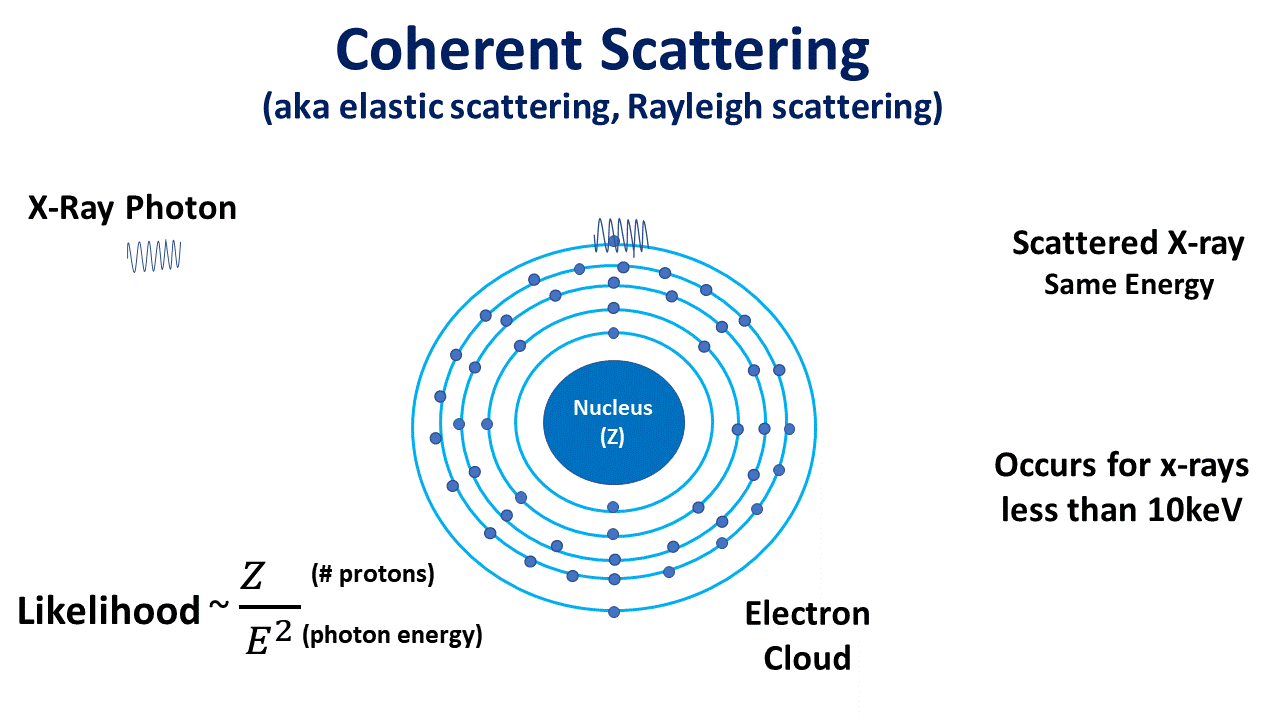
If you imagine a rubber band ball and throw it against the wall, it will come off with approximately the same energy it had going in. That’s what we call elastic scattering. That’s why this interaction is called ‘Elastic Scattering’. For diagnostic imaging Coherent scattering only occurs at energies below 10keV.
For a lot of energy spectra used in diagnostic imaging; there are not very many photons below 10keV that pass through the pre-patient attenuators. Therefore,this effect is less relevant that Compton and Photoelectric Effect for diagnostic imaging.
For completeness we will mention that the likelihood is dependent on the number of protons (i.e. Z). So, if you have more protons, you’re more likely to have coherent scattering and it’s inversely proportional to 1 over Energy squared.
As the energy increases of the X-rays this effect is less likely. This is why there is not a big effect for most diagnostic X-ray exams.
Coherent ScatterPhotoelectricCompton Scatter
| Products | X-Ray photon (=energy) |
Electron Characterictic X-Ray (low energy) |
Electron Scattered Photon (low energy) |
| Outcome | Direction change of x-ray | X-Ray stops and deposits energy locally | Some energy deposited, scattered x-ray in different direction |
| Energy Summary | Less than 10 keV | Dominant Below ~30 keV (1/E) | Dominant Above~30 keV (1/E) |
| Z Dependence | Z | Z^3 | Independent of Z |
| Impact on X-Ray Image | No Significant | Primary Contrast | Background Haze |
| Impact on Patient Dose | No Significant | Electrons, characteristic x-rays Deposit Dose | Electrons Deposit Dose |
| Impact on Staff Dose | No Significant | Not sign, except for interventions if in beam | Dominant Source of stray dose |
Energy Dependence of Interactions
In different parts of the body and at the different energy levels, photoelectric effect and Compton scattering have different contributions.
From the perspective of an image scientist or medical physicist the human body can usually be approximated as a bag of water for the soft tissue and with some bone distributed throughout.
The photoelectric and Compton effects have similar behavior as a function of energy but the energy where the transition occurs between photoelectric being dominant to Compton being dominant is at a higher energy in the case of bones.
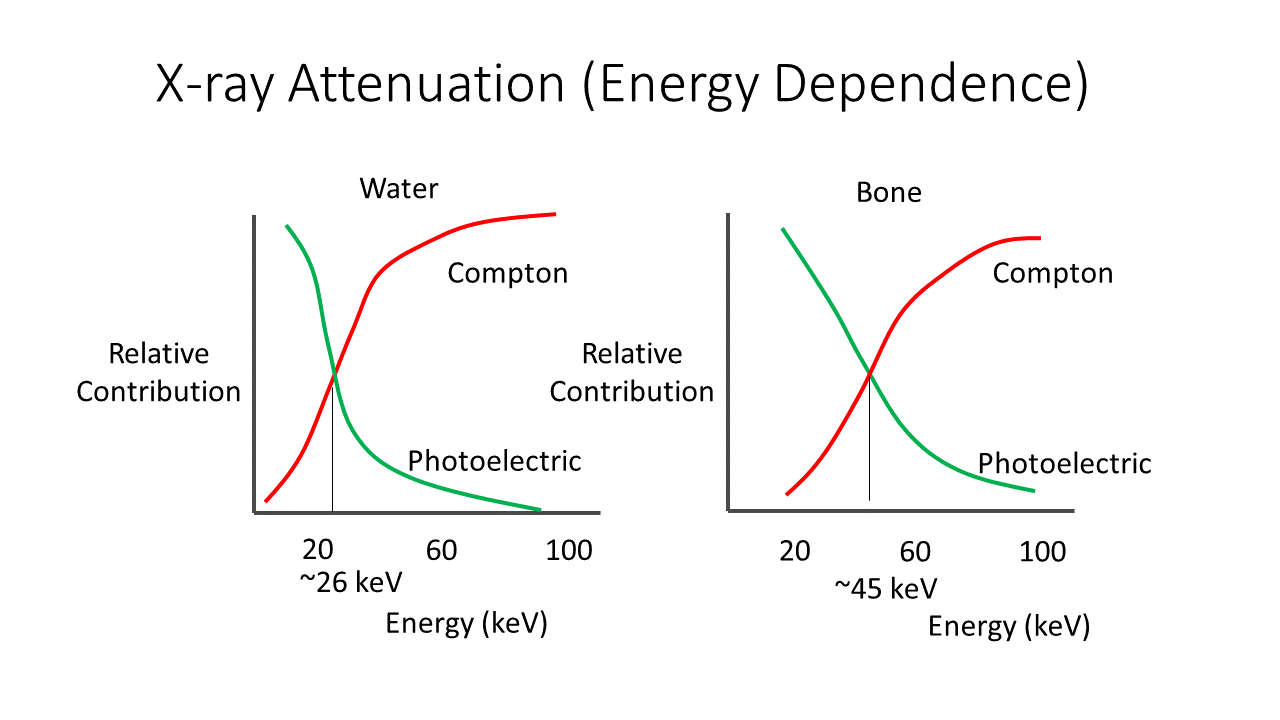
In water photoelectric is dominant up to level of 26 keV, while in bones, it is dominant up to 45 keV. Beyond those transition points Compton scatter occurs more often than photoelectric.
As discussed above the likelihood of photoelectric interactions is proportional to Z3. This is what is driving the dominance of the photoelectric up to higher energies as the bones contain Ca and other high Z elements.
'on the wavelength > 논문쓰고 졸업장 따잨' 카테고리의 다른 글
| KCI 저널 Top 6 (1) | 2025.12.05 |
|---|---|
| Compton 산란(Compton scattering) (2) | 2025.08.03 |
| TLD-thermoluminescent dosimeters (2) | 2025.07.31 |
| MCNPX의 기본/ Tally탤리란 무엇인가 /mesh tally vs tally (2) | 2025.07.17 |
| 이젠 어디다 투고 할지 /저널지 조사/impact factor/SCI/SCIE/APC (2) | 2025.07.16 |


댓글